



The Malaprabha valley is historically known for its temples. The area was controlled by the Chalukyas between the 6th and 8th centuries, with Badami or Vatapi as the capital.
The Chalukyas used these regions as their canvas to experiment with their architectural ventures. This was the period when the temples in India evolved from rock cut to their original form with a blend of features of both Nagara and Dravida style, which was named the Vesara style.
Recent studies have revealed that this was not just an experiment but was related to the cultural history of the land. Historians have also found evidence from the Paleolithic age. The architecture under the Chalukyas was a combination of the old traditional art, like the Megaliths, and the grand temple belonging to the medieval era.
I. Experimentation at Aihole
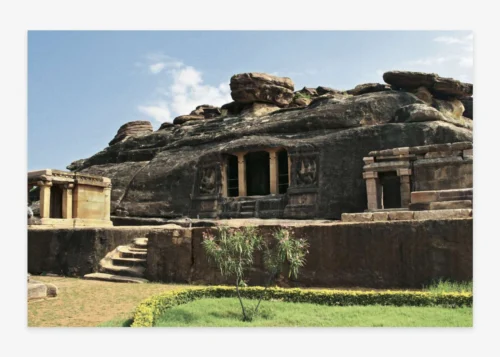
Aihole is famous for its rock-cut monuments. The region birthed the artisans who were born with the skill of carving wood from the start, and later started experimenting with sandstone later on. The site also has around 120 temples, which shows the early difficulties the artisans had to face when shifting from wood to sandstone.
The Wooden Prototype in Stone
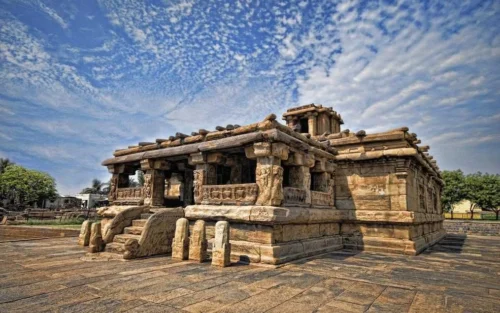
The best example of the traditional phase can be seen in the Lad Khan Temple (c. 450-500 CE). It initially copies the wooden village meeting hall, also called the panchayat hall, in stone. It also has a flat roof with stone logs, which are carved in such a way that they resemble wooden beams. The temple has a simple square plan that is yet to be evolved into the complex structures of a later period.
The Apsidal Innovation
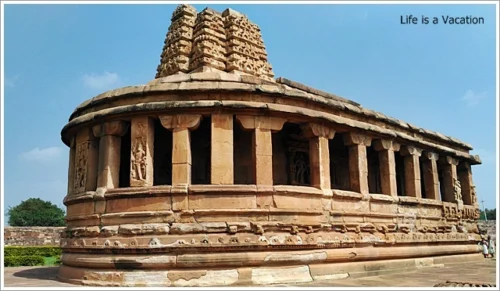
The Durga temple is the best example of the Apsidal innovation. It has an apsidal plan (elephant-backed or Gajaprishta), which is traditional to Buddhist Chaityan architecture. The architects adopted it with a vision to create a pillared corridor that runs around the sanctum, allowing the devotee to perform circumambulation (parikrama). The temple is an epitome of the early attempts of stylistic fusion with northern-style shikhara and southern-style elements.
The Megalithic Connection
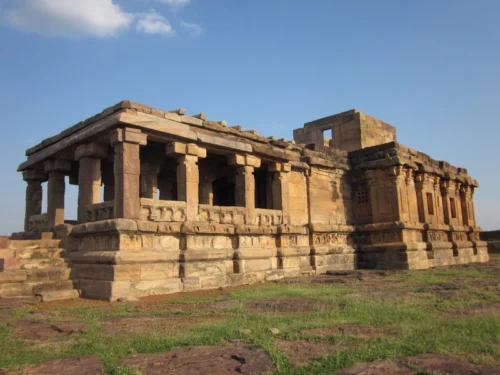
The Meguti Jain temple is the greatest example of an experiment by the artists of the period, with the structure being in close proximity to megaliths in the Iron Age. The hill houses the rubble that might have been used for both the megaliths building and the temple constructions in later times, which suggests that the sacred site was chosen specifically by the Chalukyas for the new architectural ventures.
II. Badami: The Rock-Cut Revolution and Memorial Landscapes
While Aihole was only for lab testing, Badami, the ancient capital, was for the display of imperial power. The architecture here was split into two: The famous cave temples and the structural temples that were constructed for specific purposes.
The Cave Temples of Vatapi
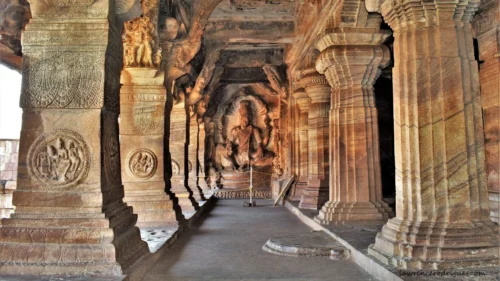
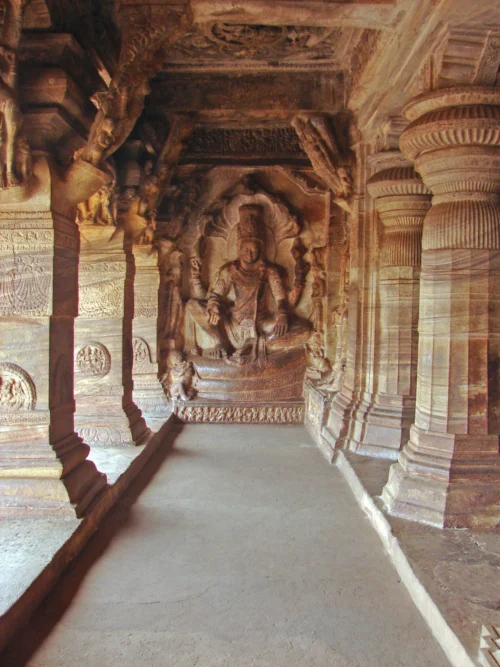
The Cave temples were constructed from the cliffs of red sandstone. The structure has four main caves devoted to Shiva, Vishnu, and the Jaina Tirthankaras. The structure represents the mastery of the artisans that they put into carving the stone into an architectural marvel. The cave also has other icons like an icon of Nataraja, a reclining Narayan with a garbhagiha deep in the temple, which became popular after this.
The Bhutnath Complex: A Zone of Commemoration
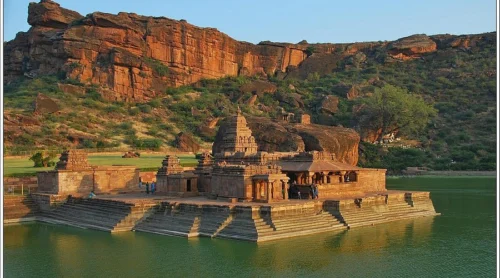
The Bhunath temple complex is the best example of Chalukyan architecture in Badami apart from the caves. It is near the Agastya Teertha tank and shows a glimpse of how the Chalukyan Planning has evolved. According to historians, the site may have been a zone of commemoration dedicated to the ritual of the dead.
The main complex of the Bhutnath temple houses Shiva as Bhuteshwara with small shrines of other deities surrounding it. The complex walls also display images related to death and the afterlife. For example, a shrine in the southern part displays a relief of a devotee wearing a sacred thread draped from the right shoulder (apasavya position), a practice reserved for post-death rituals.
The Boulder Memorials (Panchalinganaphadi)
The evolution of the temple known as the Panchaliganaphadi (massive boulder), located near the Bhutnath group, also moved from grand to miniature. The structure features the relief of gods and mini shrines. These were more than just the practice sketches, like the memorials for deceased individuals. A shrine on the top of the boulder contains a loose slab with four lingas, a feature that denotes memorials.
This points towards the fact that the temple building tradition in Badami is intertwined with the megalithic culture of raising stones for the dead. This link between the landscape and the memory of the deceased was confirmed by the hero stone (viragallu) and the padukas (carved footprints) found on the North fort. The Kappearabhata inscription is a poem on a local hero and is a textual memory written on a living rock.
III. The University of Architecture: Pattadakal
In comparison to Aihole as a primary, Badami as the secondary, Pattadakal was the final stage where art took its final form. In the 8th century, Chalukyas had fully mastered both the North and South styles of temple architectonics.
The Coronation Capital
As the literal meaning of Pattadakal, “stone of crowning”( Pattadakisuvolal), suggests, the region was the ceremonial center where the kings were ordained, and the architectonics shows grandeur and stability.
The Stylistic Synthesis
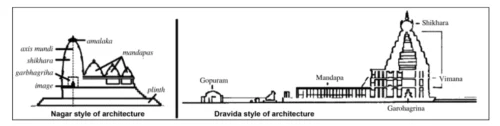
Comparing the two styles that were combined to create the Chalukyan architecture
- Dravida style: mostly found in the southern part of India, the style features a pyramidal tower called Vimana on top of the Garbhagriha and intricate gateways (gopurams). The Virupaksha temple patronized by Lokamahadevi is the best example of this style. Its walls showcase scenes of the Mahabharata and the Ramayana. The temple is inspired by the Kailasha temple of Ellora.
- Nagara style: commonly found in the northern part of India. The architectonics of these temples has a curvilinear tower (shikhara) over the sanctum, and unlike the Dravida style, it lacks the intricately large gopurams. The Jagannath Puri temple of Odisha is the unrivalled example of the Nagara style.
The Chalukyan style of temple construction is a combination of both and suggests that there is a great history of artists from different regions coming together to collaborate, which led to the creation of the Vesara style, which dominated the architecture in the Deccan region later.
Conclusion
The temple architecture of the Malaprabha Valley marks a crucial advancement in Indian art. It represents a transformation from subtractive rock-cut methods to additive structural masonry. The temples of the Malaprabha valley represent the most important part of the Indian architectonic past. It was a move from the rockcut technique to the technique of intricate carvings into the red sandstones that were locally available.
The evidence suggests that this should not only be seen as an architectonic evolution but a cultural one as well. The transition from the iron age rock cut to memorial shrines in the Bhutnath complex to a delicate royal temple in the Pattadakal is an example of human desire to carve a memory into the stone. The mini shrines found at the boulders and the great Virupaksha temple share common ties, as both defy the impermanence of life and solidify the legacy of the Chalukyas in the red sandstone of Karnataka.
REFERENCES
- Chakravarthy, P. 2011. Living Beyond Death: Chola Sepulchres. Marg: a Magazine of the Arts, Volume 63, No. 1, 22‐35.
- Darian, S. G. 2001. The Ganges in Myth and History. Motilal Banarsidass Publishers Pvt.Ltd., Delhi.
- Kadambi, H. 2011. Sacred Landscapes in Early Medieval South India: the Chalukya State and Society ca. AD 550‐750. PhD.Thesis, University of Michigan.
- Mate, M. S. and Gokhale, S. 1971. Aihole: An Interpretation. In RITTI, S. and Gopal, B. R. eds. Studies in Indian History and Culture. Dharwar, B. R. Publishing Corporation.
- Menon, S. M. 2012. Cosmic Considerations in Megalithic Architecture: An Investigation into Possible Astronomical Intent in the Design and Layout of Megalithic Monuments of the Indian Subcontinent with a View to Understanding Megalithic Knowledge Systems. Ph.D. Thesis, Manipal University.
- Menon, S. M. 2015. The Curious Case of the Galaganatha Dolmen: Possible Links Between Megalithic Monuments and Early Temples at Aihole. Heritage:Journal of Multidisciplinary Studies in Archaeology 2 2014.: 54‐73
- Menon, S. M. 2016. The “Round Mound” and its Structural Requirements: A Possible Scenario for the Evolution of the Form of the Stupa.
- Heritage: Journal of Multidisciplinary Studies in Archaeology 4 2016.: 26‐46
- Michell, G. 2014. Temple Architecture and Art of The Early Chalukyas: Badami, Mahakuta, Aihole, Pattadakal. Niyogi Books,New Delhi.